Start here
Tanah Lot kecak: is it worth it?
Is the Tanah Lot kecak and fire dance worth your evening? What the cheapest ticket leaves out, the temple ticket, rain, sunset odds and who should skip it.
Pick a sunset show date ↗Quick answer
Yes, if you are new to Bali and want dusk on the coast and a stage drama in one evening, and can live with outdoor risk. You get a reserved seat at an hour-long kecak and fire dance about 100 metres from the temple. The cheapest ticket stops there: no temple entry ticket, no transfer, no temple tour. Rain is the recurring complaint, the sunset cannot be promised, and kecak is a 1930s stage form, not a temple rite.
The cheapest ticket in one table
| Seat-only option | |
|---|---|
| Reserved seat | Yes |
| Temple entry ticket | No, bought separately |
| Transfer | No; on some other options |
| Temple tour | No; on some other options |
| Taman Ayun | No; on some other options |
| Show length | About an hour |
| Roof | None, open air |
| Free to cancel | Up to 24 hours ahead |
The short verdict
Book it if your Bali plans have room for one easy evening and you like the idea of hearing a chorus of voices do the work of an orchestra as the light goes. The effort is close to nil: you sit in a reserved seat for about an hour. The risks are the weather and your expectations. If you picture a private sunset behind the temple rock, or an ancient ceremony you have somehow been allowed to watch, you will come away disappointed. If you picture a lively staged retelling of the Ramayana on the coast, you have it about right.
What the cheapest ticket includes
One thing: a reserved seat at the kecak and fire dance on the outdoor stage in the temple area. You show your ticket at the stage by the temple and check in at least 15 minutes before the start. GetYourGuide's terms add free cancellation until a day ahead, and you may hold a seat today with nothing to pay until later. An optional audio guide is offered in Japanese and French. Beyond that, you are on your own for the road, for the temple and for dinner.
Read next: Getting to Tanah Lot by road
What it leaves out
The seat-only line is cheap because it covers so little, and that is fine as long as you know it going in. Four things come only with fuller options, or at extra cost on your own, so check the line you are selecting before you pay. Read each option's wording rather than its price: the differences between them are easy to miss on a phone.
- The temple's own entry ticket, bought separately otherwise
- Transfer to the coast and back to your area
- A guided temple tour before the show
- Taman Ayun, the moated temple in Mengwi, with its ticket
The temple ticket, explained
This catches people out, which is why it deserves its own heading. The stage lies within the temple area, about 100 metres from the temple, and on the seat-only option the temple's own entry ticket is not part of what you bought. You must purchase it separately, or pick an option that bundles it. Prices are not printed here because they belong to the temple and can change. The practical point is simple: compare the seat-only line plus a temple ticket against the bundled option, not the seat-only line alone.
What you actually watch
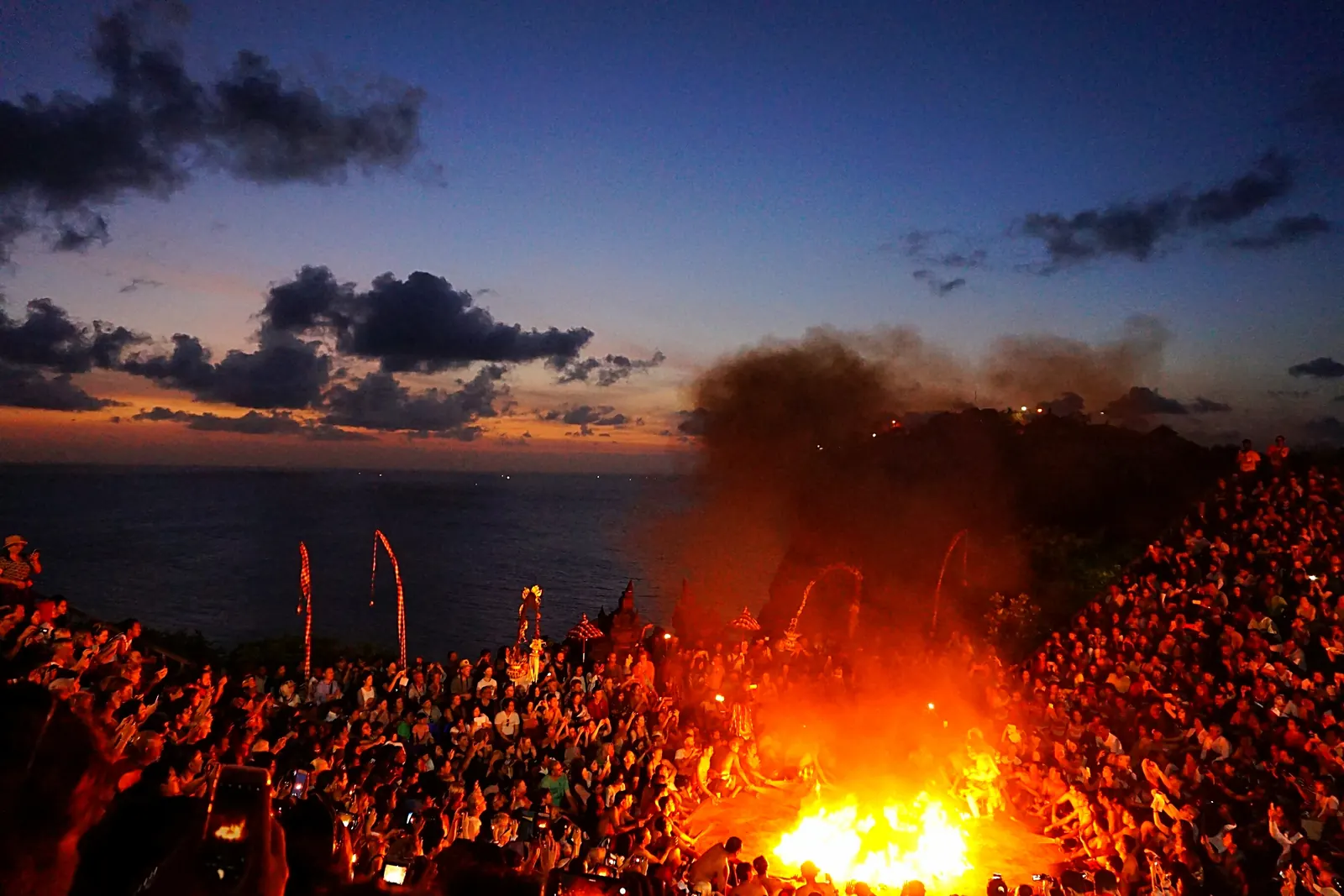
Performers sit in a circle and chant the rhythmic cak cak ke cak that gives the form its name, with no instruments. In the middle, costumed dancers play out scenes from the Ramayana, with fire worked into the drama. English Wikipedia describes the usual arc of the story: the golden deer, Sita carried off by Ravana, the search by Hanuman, and the final battle. Which scenes this company plays, and in what order, is its own choice on the night, so read that as the shape of the form rather than a programme.
A stage form, not a temple rite
Honour the temple, but do not mistake the show for worship. Wikipedia dates kecak as a popular form to the 1930s, when the German artist Walter Spies and the Balinese dancer Wayan Limbak helped reshape a trance ritual with a male chorus into a Ramayana drama for visiting audiences. The Balinese scholar I Wayan Dibia gives local artists more of the credit. Either way, you are watching a performance staged beside a sacred site. The sacred root, sanghyang, is still danced only at religious ceremonies, and no ticket gets you into one.
Read next: Kecak's roots: from trance to stage
Rain, cloud and the sunset
Rain is the complaint that comes back again and again from past visitors, and it is the main reason to hold off booking until you can see a forecast. The stage is open to the sky, so pack a light jacket or an umbrella. Free cancellation ends 24 hours before, which gives you one decision point. Sunset is the other unknown. The show is timed for it, and the setting is praised when the sky behaves. But cloud decides the colour, and nothing guarantees every seat a clear line to the temple rock.
Seat, arrival and check-in
Your seat is reserved, yet you are still advised to arrive early for the best view, so aim to be there well before the 15-minute check-in limit. Tickets are limited, and evenings in busy months can fill. The walk from the road runs past outdoor souvenir stalls and three smaller shrines, and at least one past visitor found the stage hard to locate, so leave spare time and keep your confirmation's map pin ready. Flash photography and loud disturbances are not allowed during the show, and pets stay at home.
Which option to choose
Choose by how much of the evening you want arranged for you. Each step up the ladder adds cost and hours, and removes one thing you would otherwise organise yourself. If you already have a driver for the day, the lightest line usually makes sense. If you have no plan for the afternoon and no car, a fuller option saves you the arranging.
- Seat only: you have your own driver and want just the show
- Seat plus temple ticket: you want both and can get there
- With transfer: you want the road taken care of
- With temple tour: you would like the rock and its story explained
- With Taman Ayun: you want a fuller afternoon before the stage
Who this isn't for
Skip it if you are looking for a religious ceremony, because this is theatre. Skip it if you need a roof, or if a washed-out evening would ruin a short trip with no spare night. Babies under one are not suitable, and young children may find fire and sustained loud chanting a lot; an adult has to stay with them throughout. Skip it too if crowds at a popular landmark spoil a place for you, since Wikipedia counts Tanah Lot among the most visited sites in Indonesia. If you would rather earn your view, the next guide compares the Batur hike.
Read next: Tanah Lot sunset or Batur sunrise?
How to book it
Open the date picker and look for your evening. On the next screen, read each option line for four words: temple, transfer, tour and Taman Ayun. Those tell you what you are paying for. Switch to your own currency for the full total, and reserve without paying today if you want to keep the choice open until the weather forecast firms up. Your confirmation shows the start time, because it moves with the sunset through the year.
Frequently asked questions
Is the Tanah Lot kecak better than a temple visit alone?
It is a different thing. A temple visit gives you the rock, the tide and the shrines. The show gives you the chant and the story. Many options combine them, and the seat-only line expects you to buy the temple ticket separately if you want both.
How much of the temple do I see with the seat-only ticket?
Only what you can see from the stage and the way to it, and that view is not guaranteed. Walking the temple grounds needs the temple's own entry ticket, bought separately or included in a fuller option.
Does it run when it rains?
Nothing here can promise either way. The stage is open air and rain is the recurring complaint. Watch the forecast before the free cancellation window closes 24 hours ahead, and use the contact on your confirmation on the day.
How long should I allow?
The show runs about an hour, and options with temples and transfer take up to five hours. Add your own road time on the seat-only option, plus time to reach the stage at least 15 minutes before the start.
Is the chanting in a language I need to know?
No. The chorus is rhythm and sound, and the action tells the story. Wikipedia says the narrator usually speaks Balinese and Sanskrit. An optional audio guide is offered in Japanese and French, so read a plot summary in advance if English is your language.
Sources