The form
Kecak's roots: from trance to stage
How a Balinese trance chorus became a Ramayana drama in the 1930s, who shaped it, what the chanters are doing, and how to read the fire in the story.
Pick a sunset show date ↗Quick answer
Kecak grew from sanghyang, a Balinese trance dance held at religious ceremonies. In the 1930s, the chorus was reshaped into a Ramayana drama for visiting audiences by Walter Spies and the dancer Wayan Limbak, though one Balinese scholar argues local artists were already moving that way. Knowing this helps you watch the Tanah Lot show for what it is: a performance with sacred roots, staged beside a sacred site.
The sacred root
English Wikipedia describes sanghyang as a traditional sacred Balinese dance, resting on the belief that an unseen force, the hyang, enters the body of an entranced performer. The variants are striking. In sanghyang dedari, young girls carried on men's shoulders dance in trance; in sanghyang jaran, boys ride coconut hobby horses in and around a fire. These dances belong to religious ceremonies, and they are not what a ticket buys. The kecak article calls sanghyang a trance-inducing exorcism dance and names it as the root of the form.
What changed in the 1930s
Before the 1930s, the chant belonged to trance, sung by men around entranced performers. Then Walter Spies, German by background, a painter and musician settled on the island, took an interest and turned it into a Ramayana play aimed at foreign visitors. His partner in this was the dancer Wayan Limbak, whose overseas tours with Balinese troupes carried the sound abroad. Wikipedia uses this story as an example of an outside power turning a practice embedded in a culture into art for display.
The other side of the story
Not everyone gives Spies the credit. I Wayan Dibia, who performs, choreographs and writes on the form, says change was already under way before Spies appeared. On his account, Limbak was using movements from baris in the chorus leader's part by the 1920s. Spies admired this and proposed the Ramayana as a subject, with voices replacing the usual gamelan. That is a fairer way to think about it: a shared invention, with Balinese hands on it throughout.
What the chanters are doing
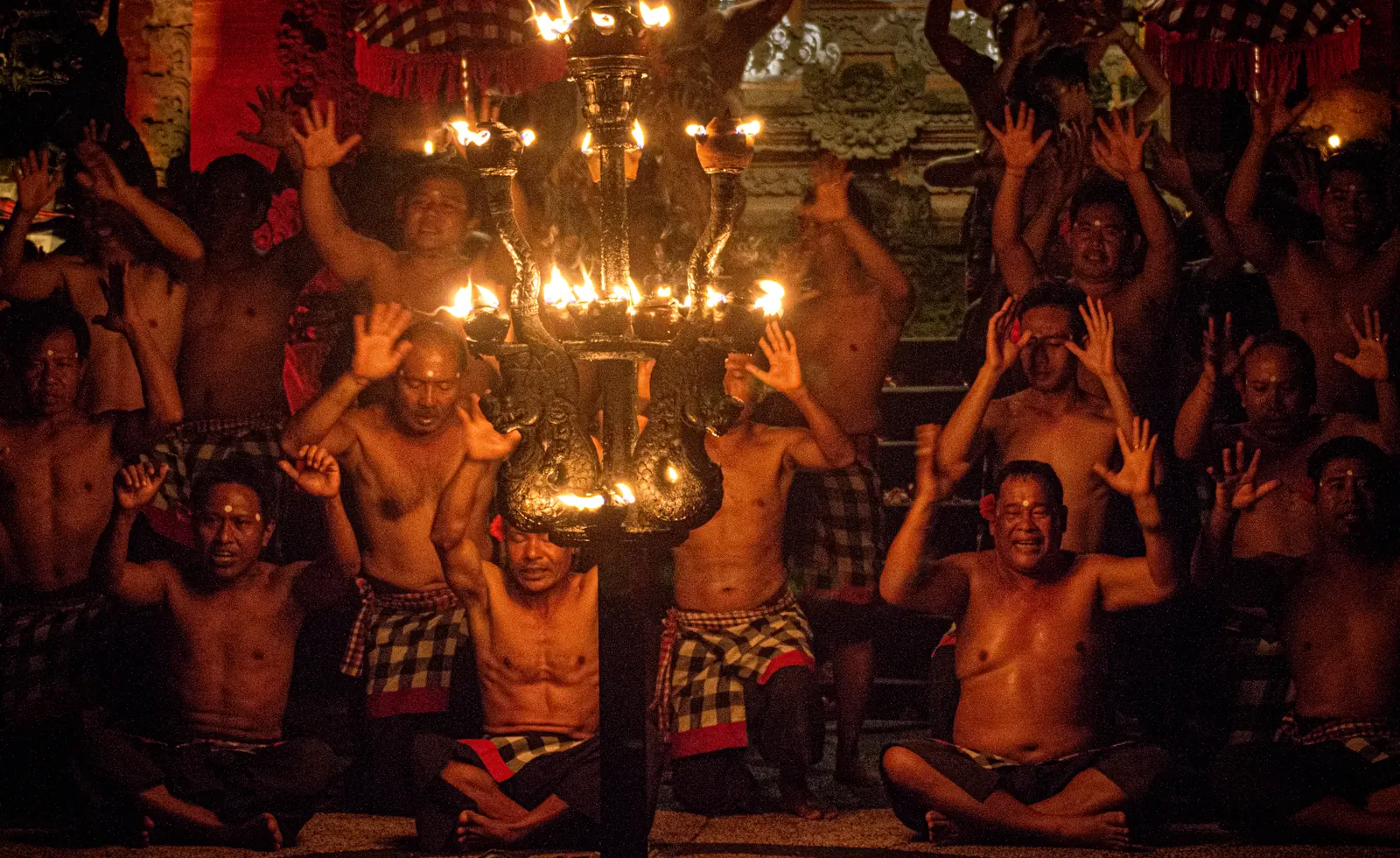
Wikipedia pictures concentric circles of men around a coconut oil lamp, moving left and right and chanting chak ke-chak in a slow beat that gradually speeds up as hands rise and tremble. There are no instruments. Inside that chorus, a single voice pulses po-po-po to hold time, a senior man shouts when to stop and start, a singer floats a line above it all, and a dalang narrates in Balinese and Sanskrit. Watch for those roles; once you can hear them, the wall of sound becomes an ensemble.
The story being told
Tradition credits Valmiki with the Ramayana, the Hindu epic retold in many versions across South and Southeast Asia. The kecak telling usually opens with Rama and Sita in exile in the forest. A golden deer appears, Ravana carries Sita away, the vulture Jatayu fights him, Hanuman goes looking for her, and it ends in the battle between Rama and Ravana. The chanters take parts too, as Rama's Vanaras and Ravana's demons. A stage can cut or reorder any of this, so don't expect every episode.
Who dances
Two groups share the stage. The chanters are men, usually villagers from the area with other jobs to finish before they perform, according to Wikipedia. The main dancers take the named parts: Sita, Rama, Lakshmana, Ravana, Hanuman, Jatayu. Gentle, smooth roles such as Rama, Sita and the golden deer are sometimes danced by women, and men play the muscular characters. The chorus stayed male for decades, until a women's group formed in 2006. Local practice varies, so take this as the general pattern.
How to read the fire
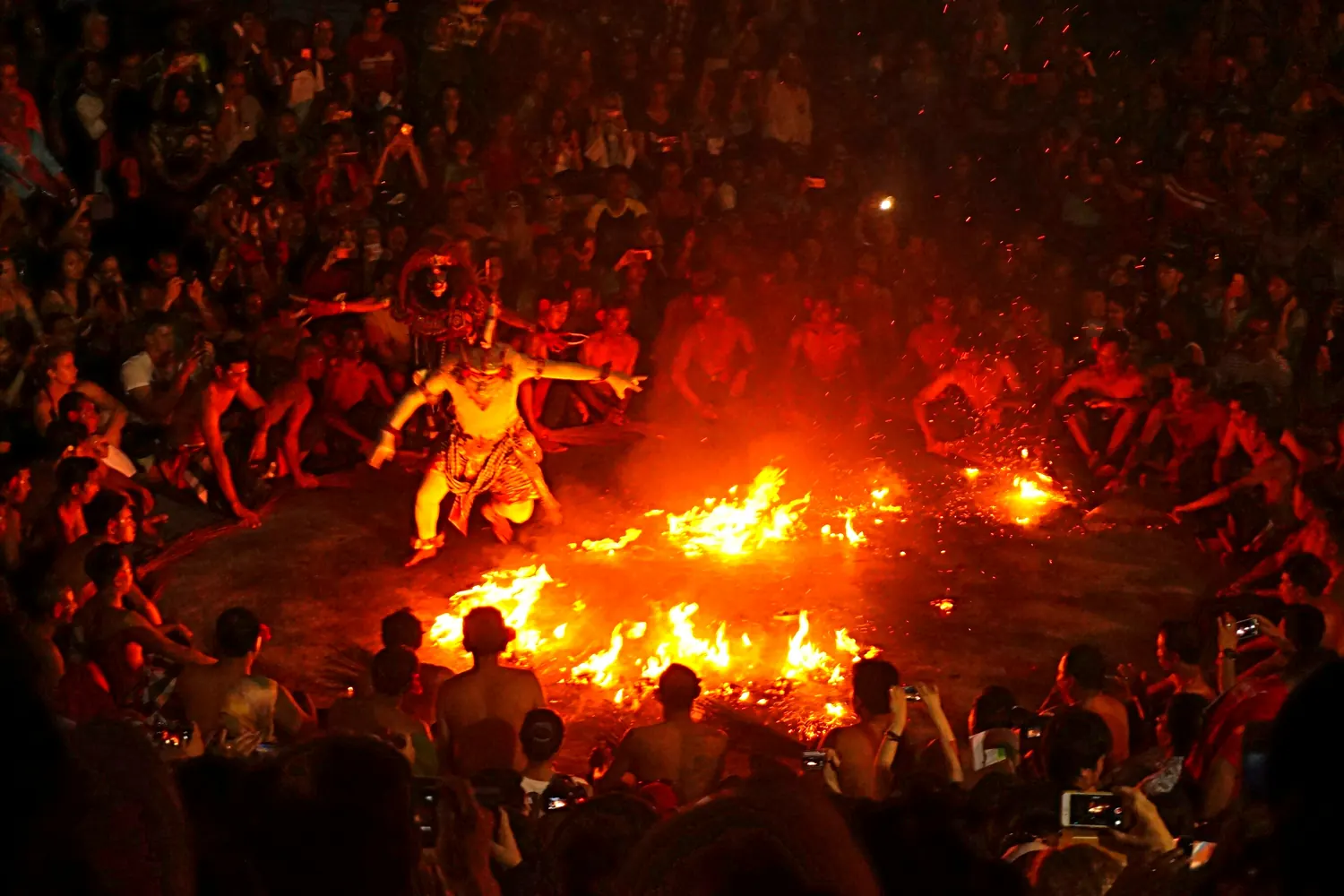
The fire has a story behind it. In a common telling, Hanuman is captured in Lanka and Ravana has his tail set alight, so he breaks free and sets the city ablaze from the rooftops. Wikipedia says trance rituals can accompany that moment, with the dancer blessed by a priest before the fire kicking that follows. Whether a given show treats it as ritual or as theatre is not something an audience can check. Sit back, respect the moment, and stay out of the way when the embers fly.
What this means for your evening
It changes what you should look for. You are not an intruder at a ceremony, and you are not watching something invented last year either. You are watching a form with a sacred ancestry and nearly a century of stage life. Applaud when others do, keep the flash off because it is not allowed, and treat the temple nearby with respect. Our first guide turns to the practical side: what the ticket includes, and what to do about rain.
Read next: Tanah Lot kecak: is it worth it?
Sources